How Does Acoustic Leak Detection Work?
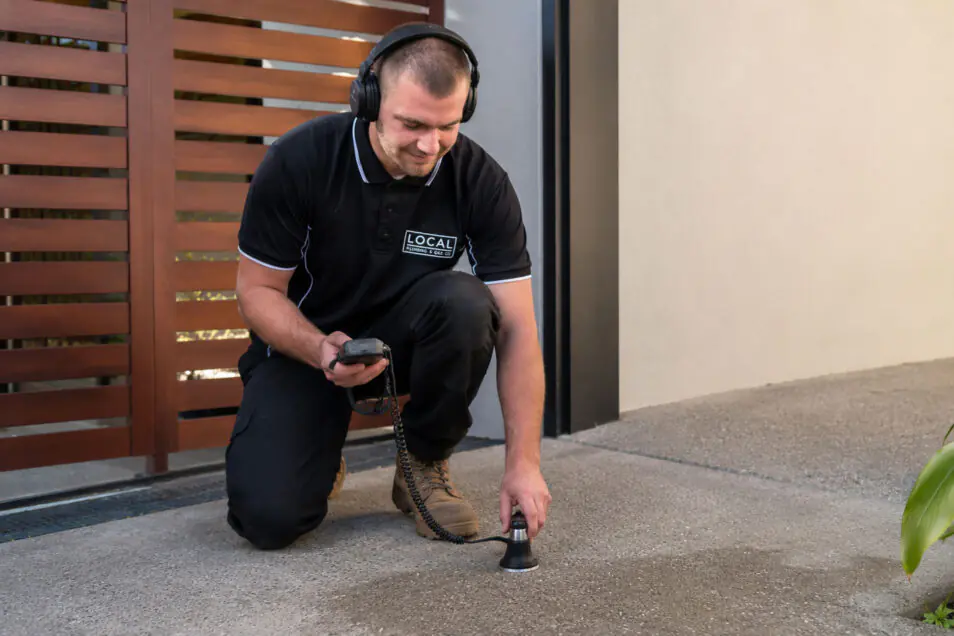
Hidden water leaks are frustrating because the damage can show up long before the source is easy to see. So, how does acoustic leak detection work? It uses sensitive listening equipment to help pick up the sound or vibration made when pressurised water escapes from a pipe.
At Local Plumbing & Gas Co., we often hear from Gold Coast homeowners after they notice a higher water bill, damp flooring, wet ground or a running-water sound with no obvious leak. This guide explains what acoustic leak detection listens for, when it can help, what affects accuracy and when a licensed plumber should investigate the issue properly.
How Does Acoustic Leak Detection Work?
Acoustic leak detection works by using sensitive listening equipment to pick up the sound or vibration made when pressurised water escapes from a pipe. A plumber listens across the suspected area, compares sound strength at different points and uses those findings with other checks to narrow down the likely leak location.
The key word here is “likely”. Acoustic equipment can be very useful, but it does not magically see through concrete, walls or soil. It helps our plumbers follow the sound pattern so we can work out where the leak is most likely coming from before repair work is considered.
For Gold Coast homes, this can be especially helpful when there is a hidden water leak under a slab, behind a wall, below paving or somewhere in the yard. Instead of guessing where to open up the area, acoustic leak detection gives the inspection a more focused starting point. It supports on-site diagnosis, not guesswork from one damp patch or one noisy pipe.
What Acoustic Leak Detection Is Listening For
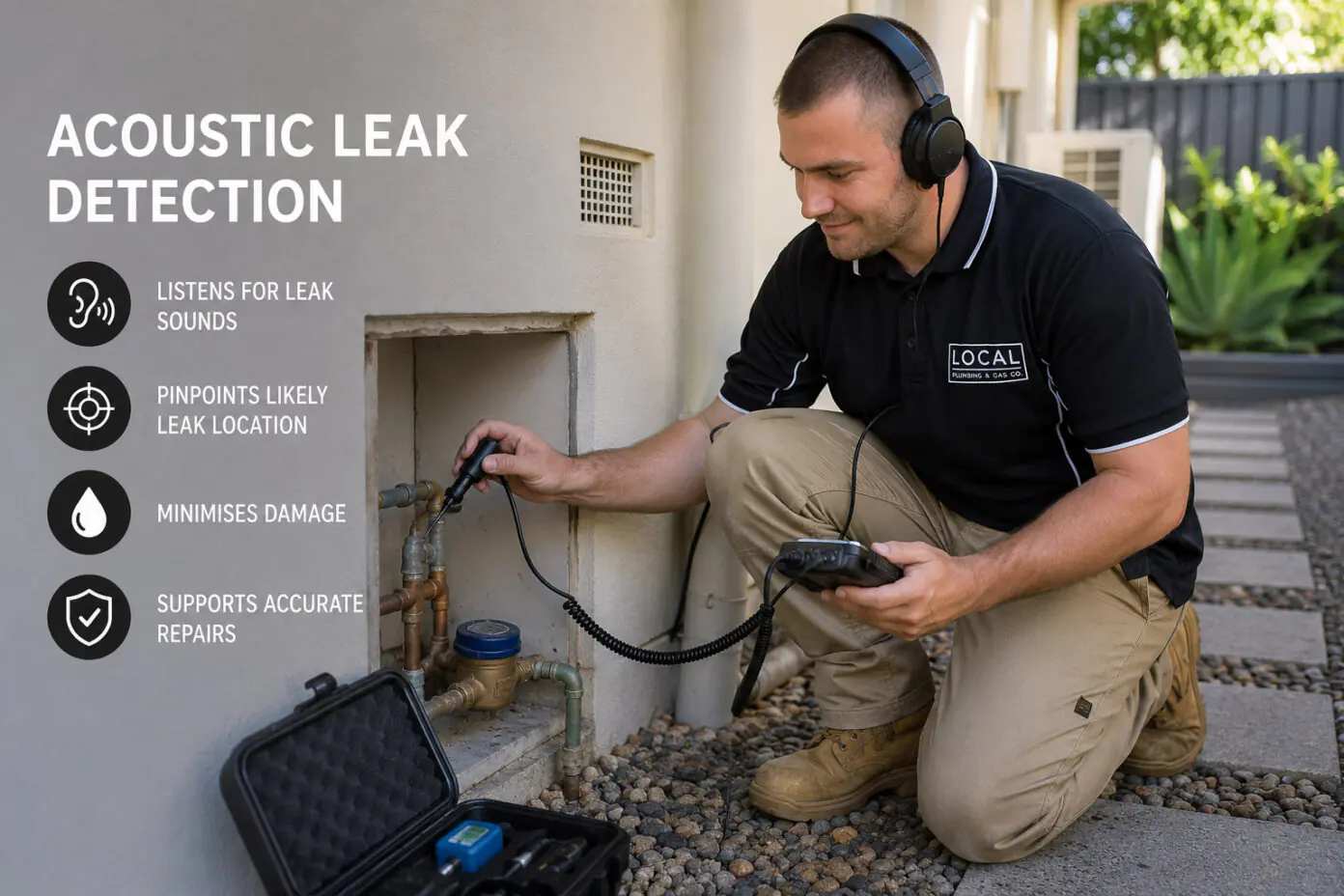
A hidden leak does not always sound like running water. Depending on the pipe, pressure and surrounding surface, it may create a hiss, whoosh, tapping sound or steady vibration. Acoustic leak detection is about listening for those patterns and comparing where the sound is strongest.
Our plumbers are not just listening for any noise in the wall or ground. We are looking for sounds that line up with water escaping under pressure from concealed pipework. That sound can travel through copper, plastic, concrete, soil, paving and nearby fittings, which is why the clearest signal is not always directly above the leak.
The leak detection equipment may include sensitive listening equipment, a ground microphone or, in some situations, acoustic correlation equipment that helps compare sounds from different points. The exact setup depends on the property, the suspected pipe route and the kind of leak being investigated.
Background noise also matters. Traffic, pumps, appliances, wind, rain and normal household water use can all make it harder to separate leak noise from other sounds. This is one reason acoustic leak detection works best as part of a proper on-site investigation, not as a single reading taken out of context.
When Acoustic Leak Detection Can Help Find Hidden Water Leaks
Acoustic leak detection can be helpful when there are signs of water loss but no obvious burst pipe, dripping tap or visible leak. It is often used to narrow down hidden leaks behind walls, under concrete slabs, below paving, in gardens, along driveways or around underground pipe runs.
For Gold Coast homeowners and property managers, the main value is focus. If a leak is hidden, guessing can lead to unnecessary digging, cutting or opening up the wrong area. A proper inspection helps our plumbers work from the symptoms, check likely pipe routes and use the right detection method for the site.
This is where professional water leak detection can make a real difference. Acoustic testing may be one part of the process, alongside other checks such as moisture testing, thermal imaging or pressure testing, depending on what we find at the property.
If the suspected leak is below a driveway, garden, paved area or buried pipe route, underground leak detection may also be relevant. The aim is to narrow the search area before any access or repair work is considered.
Signs You May Need Professional Water Leak Detection

A hidden leak can be easy to miss at first. We often hear from homeowners after one small clue keeps showing up, then another follows. By the time water is visible, the leak may have already affected flooring, walls, cabinetry or the ground outside.
Queensland Government leak guidance notes that many household leaks are not easily detected and can lead to high water bills. The City of Gold Coast also advises property owners who suspect or discover a concealed leak to contact a licensed plumber to help locate and repair it.
For local water billing and concealed leak information, check the current City of Gold Coast water leaks guidance. Do not assume a high bill means a rebate or remission will apply. The leak still needs to be investigated and repaired properly.
Common signs that may point to a hidden water leak include:
- a higher than usual water bill
- water meter movement when taps and appliances are off
- damp walls, swollen skirting boards or soft flooring
- wet patches in the yard, driveway, garden or paved areas
- reduced water pressure or inconsistent flow
- a running-water sound when no fixtures are being used
- mould, musty smells or unexplained water damage
None of these signs confirms the exact leak location by itself. They are clues that the issue needs checking properly. If the signs keep coming back, professional water leak detection can help narrow down what is happening before repair work starts.
If water is near power points, appliances, switchboards or electrical fittings, keep clear of the area. Water and electricity are a serious risk, so the safest step is to avoid the affected area and call for help.
What Can Affect Acoustic Leak Detection Accuracy?
Acoustic leak detection can help narrow down the likely leak location, but site conditions affect how clearly the leak can be heard. A strong signal in one property may be much harder to interpret in another, even when the leak is similar.
Water pressure is one of the biggest factors. A leak in a pressurised pipe usually creates more sound than a slow seep or leak with very low pressure. Pipe material also matters, because copper, plastic and other pipe types carry sound differently.
Depth and surface conditions can make a difference too. A leak under soil, paving, concrete or a thick slab may not sound the same at the surface. Landscaping, retaining areas and external surfaces can also change how sound travels through the ground.
Water can move away from the actual leak point before it appears at the surface. That is why a wet patch in the yard or damp area inside the home may not sit directly above the damaged pipe. Our plumbers look at the sound, the symptoms and the property layout together.
Background noise from traffic, pumps, appliances, rain or nearby water use can also interfere with what the equipment picks up. This is why our plumbers treat acoustic readings as part of the investigation, not the whole answer. The results still need to be interpreted on site, and other checks may be needed before any water leak repairs are recommended.
Acoustic Leak Detection Vs Thermal Imaging, Moisture Checks And Pressure Testing
Acoustic leak detection is only one way to investigate a hidden leak. In many cases, our plumbers use more than one method because each tool gives a different type of information. If you want to understand the thermal side in more detail, our guide to thermal leak detection explains how thermal cameras can help identify temperature differences linked to moisture movement.
The right approach depends on the symptoms, pipe location, surface conditions and what we find on site.
| Method | What It Helps With | Best Used For | Limits |
| Acoustic leak detection | Listening for sound or vibration from escaping pressurised water | Hidden pipe leaks, underground pipes and slab-adjacent leaks | Accuracy depends on pressure, pipe material, depth and background noise |
| Thermal imaging | Reading temperature differences that may suggest moisture or water movement | Damp areas, walls, ceilings, floors and suspected moisture paths | A thermal camera does not directly see water inside every pipe and still needs interpretation |
| Moisture testing | Checking whether materials are damp | Confirming affected areas and moisture spread | A moisture meter may show where water has travelled, not where the leak started |
| Pressure testing | Checking whether a plumbing line is holding pressure | Confirming whether a line may be leaking | It should be carried out and interpreted by a licensed plumber |
This is why leak detection is rarely about one reading from one tool. Acoustic equipment may help narrow the likely leak point, while thermal imaging or moisture testing may help show where water has moved. If the leak is confirmed, the next step is working out the safest and most practical repair.
What Happens During A Professional Leak Detection Visit?
A professional leak detection visit usually starts with the symptoms. Our plumbers will want to know what you have noticed, when it started and whether it is getting worse. Details such as a high water bill, wet ground, damp flooring or a sound of running water can help narrow the first areas to check.
For property managers, access notes and tenant observations can make the visit more focused. It helps to know where moisture has appeared, whether the meter has changed, whether the issue is affecting one area or several, and whether the signs are getting worse.
From there, the inspection is guided by the property. A plumber may check likely pipe routes, fixtures, external areas, meter behaviour and visible moisture signs before using acoustic listening equipment across the suspected zones. If the sound pattern is unclear, other checks such as thermal imaging, moisture testing or pressure testing may be needed.
The goal is not to start pulling the property apart. It is to build a clearer picture of where the leak is likely to be, what may be affected and what the next step should be. Once the findings are understood, your plumber can explain whether further investigation, access or repair work is needed.
QBCC guidance states that most plumbing work in Queensland is regulated and requires a QBCC licensed plumber or drainer. That is why detection findings should be interpreted by a licensed plumber before repair work begins.
What To Do If You Suspect A Hidden Water Leak
If you suspect a hidden water leak, start by noting what you can see, hear or smell. A higher water bill, damp patch, soft flooring, musty smell or running-water sound can all help your plumber understand where to begin.
You can also make safe, non-invasive observations. Check whether wet areas are spreading, whether more than one room or fixture is affected, and whether the water meter appears to move when no water is being used. Treat this as a clue, not a complete diagnosis.
If water damage is spreading and you can safely access the mains tap, turning off the water can help limit further damage. Keep clear of any area where water is near power points, appliances, switchboards or electrical fittings. Do not cut into walls, dig up the yard, lift flooring or open pipework based on a guess.
When customers call us about hidden leaks, the most useful details are when the signs started, whether they are getting worse and whether more than one area is affected. If leak detection confirms a damaged pipe or fitting, our team can explain the next step for water leak repairs based on what is found on site.
Frequently Asked Questions
How Can Acoustic Methods Be Used To Detect Water Leaks?
Acoustic methods can be used to detect water leaks by listening for the sound or vibration made when pressurised water escapes from a pipe. A plumber compares sound patterns across the suspected area, then uses those readings with other checks to narrow down the likely leak location.
How Do Acoustic Leak Detectors Work?
Acoustic leak detectors work by picking up sound or vibration that may not be easy to hear without specialist equipment. The equipment helps a plumber listen through surfaces such as concrete, soil, paving or walls, then compare where the leak noise is strongest and most consistent.
Do Water Leak Detectors Really Work?
Water leak detectors can work well, but they are not magic. Acoustic equipment, thermal imaging, moisture testing and pressure testing all provide clues. The accuracy depends on the leak type, pipe material, pressure, depth, background noise and how the results are interpreted on site.
Can Acoustic Leak Detection Find Leaks Under Concrete?
Acoustic leak detection may help find leaks under concrete, especially when the pipe is pressurised and the sound travels clearly enough to the surface. It still depends on the depth, slab thickness, pipe material and background noise. Other checks may be needed before repair work begins.
Is Acoustic Leak Detection Better Than Thermal Imaging?
Acoustic leak detection is not always better than thermal imaging. It is different. Acoustic equipment listens for sound from escaping water, while thermal imaging looks for temperature differences that may suggest moisture movement. Our plumbers may use both methods if the signs point to a hidden leak.
Is Acoustic Leak Detection Non-Invasive?
Acoustic leak detection is generally non-invasive because it helps investigate a suspected leak without immediately cutting into walls, lifting flooring or digging. That does not mean repairs will always be non-invasive. If a leak is confirmed, access may still be needed to repair the damaged pipe or fitting.
Need Help Finding A Hidden Water Leak On The Gold Coast?
Acoustic leak detection can be a useful way to narrow down a hidden leak, but the result still needs to be checked in context. The sound, pipe material, pressure, surface conditions and signs around the property all matter.
If you have noticed a high water bill, damp area, wet ground or running-water sound with no clear source, Local Plumbing & Gas Co. can help investigate the issue properly. Our plumbers use leak detection methods to work out what is happening, explain the likely next step and help you avoid guesswork where possible.
For help with a suspected hidden leak, contact Local Plumbing & Gas Co. for professional water leak detection on the Gold Coast.