Tree Root Intrusion on the Gold Coast: Signs, Causes and Solutions

Tree root intrusion on the Gold Coast is one of the most common causes of blocked drains on the Gold Coast — and one of the most misunderstood. Most homeowners don’t know there’s a problem until a drain backs up, a toilet stops flushing, or a plumber puts a camera down and finds a pipe half-full of roots that have been growing undisturbed for months.
It’s a problem that’s particularly prevalent here. The Gold Coast’s subtropical climate, seasonal dry periods, and established suburbs full of mature trees create conditions that accelerate root intrusion into underground sewer and drainage pipes. Older homes in areas like Robina, Labrador, and Southport often have clay or concrete pipes that are especially vulnerable to entry.
This guide covers how tree roots get into your pipes, the warning signs to watch for, what happens if the problem goes unchecked, and how we detect, clear, and prevent root intrusion across the Gold Coast.
How Tree Roots Get Into Your Pipes
Tree roots in sewer pipes don’t need a major fracture to find a way in. Roots can penetrate through hairline fractures, deteriorated rubber joint seals, or the connection points where pipe sections join together — gaps that are often invisible to the naked eye.
The mechanism is straightforward. Every functioning sewer pipe leaks a small amount of warm, moist vapour into the surrounding soil. Tree roots detect this moisture gradient and grow toward it. When a root tip finds a micro-fracture or joint gap, it penetrates and begins to grow inside the pipe. Once inside, it has access to a constant supply of water and nutrients and continues to expand, forming a dense mass that catches debris, toilet paper, and waste. Over time, that accumulation builds into a blockage.
Not all pipe materials are equally vulnerable:
- Clay pipes — Common in Gold Coast homes built before the 1980s. Clay has joints every 60cm that deteriorate with age and are highly susceptible to root penetration. These are the highest-risk pipes on the network.
- Concrete pipes — Also found in older systems. Concrete cracks as it ages, creating entry points that roots exploit readily.
- PVC pipes — Standard in modern construction. Smooth and non-porous, making them significantly more resistant to intrusion — but still vulnerable at joints if seals have degraded or installation was poor.
If your home was built before 1980, there’s a reasonable chance your sewer lateral is clay or concrete — the pipe materials most vulnerable to tree roots in drain pipes. Cracked pipes in these older systems are often what allows root intrusion to take hold. That’s worth knowing before problems develop.
Case Study
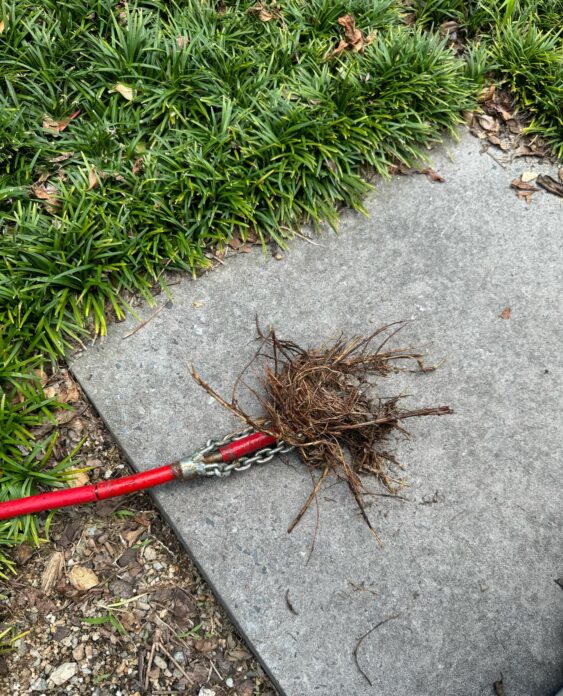
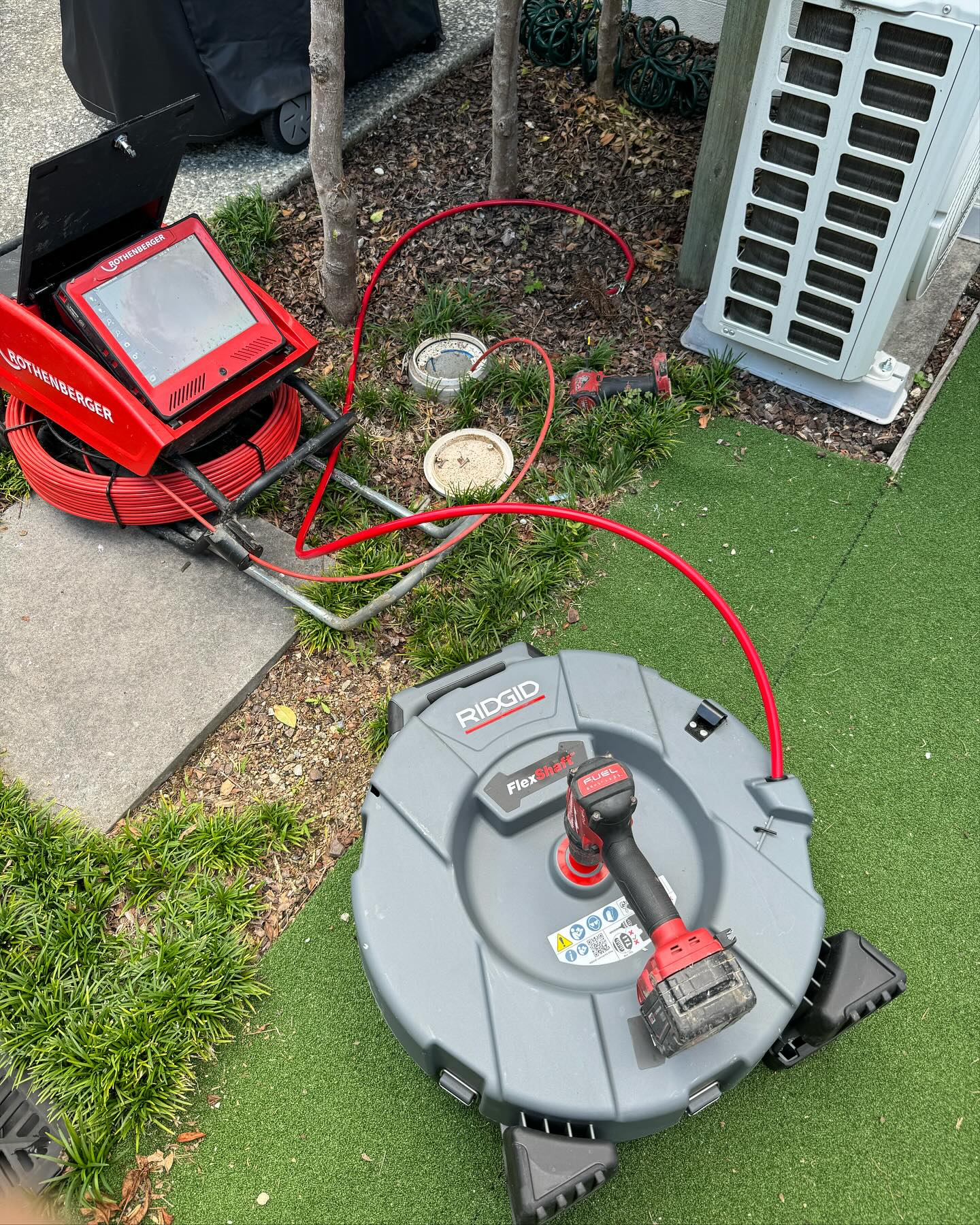
In a recent example of this issue, we attended a job on the Gold Coast where tree roots had grown into the storm water drain pipes, causing a blockage. The images below illustrate the extent of the intrusion. However, this was no match for our team’s expertise and the use of our RIDGID FlexShaft. We cleared the blockage efficiently, restoring the storm water system to its optimum function.
Why the Gold Coast Has a Higher Risk Than Most
Root intrusion happens everywhere trees grow near underground pipes, but several factors make it more common and more aggressive on the Gold Coast than in many other parts of Australia.
Climate and seasonal patterns. The Gold Coast’s subtropical climate produces year-round tree growth. During the dry winter months, trees actively seek water sources, and sewer pipes provide a reliable supply. Once roots establish inside a pipe during the dry season, the summer wet season accelerates their growth significantly. A minor intrusion in June can become a serious blockage by December.
Local tree species. Certain trees common on the Gold Coast have particularly aggressive root systems. The species most frequently implicated in sewer root intrusion here include:
- Ficus (fig varieties) — Extremely aggressive surface roots. One of the most common causes of Gold Coast sewer blockages, widespread in older streets and established gardens.
- Poinciana (Delonix regia) — A Gold Coast icon, but with a wide-spreading root system that actively seeks water. Common in hinterland and older coastal suburbs.
- Bottlebrush (Callistemon species) — Popular garden plant with roots that follow drainage moisture aggressively.
- Eucalyptus (gum trees) — Particularly problematic on acreage and hinterland properties, with extensive root systems.
- Jacaranda — Widespread in Gold Coast streets; moderate risk in older pipes.
If you have any of these species within 10–15 metres of a sewer line, the risk of intrusion is elevated — particularly in properties with older infrastructure.
Established suburbs and ageing infrastructure. Areas like Labrador, Chirn Park, Mermaid Beach, Ashmore, and Benowa have older drainage systems where pipe joints and seals have had decades to deteriorate. These suburbs also tend to have the most established tree canopy — which means root systems that have had years to extend toward underground infrastructure.
Queensland tree-keeper responsibilities. It’s worth noting that under Queensland law, tree keepers — the owners or occupiers responsible for a tree — are responsible for the whole tree, including its root system. If your tree’s roots damage a neighbouring property’s pipes, that responsibility extends to the damage caused. Strategic tree selection and placement isn’t just a practical consideration; it’s a legal one.
Signs of Tree Root Intrusion
Root intrusion rarely announces itself loudly. It develops gradually, and the early signs are easy to dismiss as minor inconveniences. Knowing what to look for is what separates a relatively straightforward clearance job from a collapsed pipe.
Early signs (roots present, flow not yet significantly restricted):
- Slow drainage from sinks, showers, or baths — particularly after heavy use
- Faint gurgling noises from floor wastes when the toilet is flushed
- Occasional drain odour that clears on its own
Progressive signs (partial blockage forming):
- Gurgling consistently from multiple fixtures
- Recurring toilet backups that plunging temporarily relieves
- Slow drainage across several fixtures at once — not just one outlet
Advanced signs (significant blockage or pipe damage):
- Complete toilet backup or sewage overflow
- Persistent sewage smell inside or outside the home
- Lush patches of unusually green grass in the yard — indicating an underground leak feeding the surface
- Wet ground in the yard without a corresponding rainfall event
An important signal: if multiple fixtures are draining slowly or backing up at the same time, the problem is almost certainly a sewer line backup in the main line rather than a single internal drain. That’s a different scope of problem and needs professional assessment — not a plunger.
What Happens If You Ignore Root Intrusions

Root intrusion doesn’t stay the same. Left unchecked, it follows a predictable escalation path — and the cost of addressing it increases at every stage. Tree root intrusion in a sewer line is particularly serious because the main line serves every fixture in the home; when it fails, nothing drains.
In the early stages, roots create a partial blockage that traps debris and waste. Drains slow, backups become more frequent, and the pipe is under increasing pressure from the expanding root mass. At this stage, a CCTV inspection and hydro jet clearance can resolve the problem without major intervention.
As roots continue to grow, they exert pressure on the pipe walls. Clay and concrete pipes crack under this pressure. Once a pipe cracks, the entry point widens and root growth accelerates. Drainage performance deteriorates rapidly.
In the most serious cases, roots cause complete pipe collapse. Once it reaches that point, drain repairs means excavation, full pipe replacement, and potentially significant disruption to landscaping, driveways, or structures above. The costly repairs at this stage can run into thousands of dollars — versus a fraction of that for early intervention.
There are also health and structural implications. Sewage backup into the home creates unsanitary conditions and exposure to harmful bacteria. Root pressure is one of the common plumbing leak causes under a slab, and sustained leaks like this saturate the soil, with foundation damage from that kind of prolonged moisture exposure one of the more serious—and expensive— downstream consequences of ignored root intrusion.
The pattern we see most often: a homeowner notices slow drains and recurring blockages, uses a chemical drain cleaner or plunger, gets temporary relief, and repeats the process for months. Recognising when a sewer line needs repair, rather than another clear, is what breaks that cycle, because the roots keep growing the whole time. By the time they call us, what was a straightforward clearance has become a structural repair.
How We Detect and Clear Tree Root Intrusion
Clearing roots without first understanding what you’re dealing with is a mistake. High-pressure jetting into a structurally compromised pipe can cause further damage. The right sequence is always inspection first, then treatment.
CCTV drain inspection
A waterproof drain camera on a flexible cable is fed through the pipe, transmitting live footage that gives us a complete picture of what’s inside — a pipe inspection that can’t be done any other way. A CCTV drain inspection confirms whether root intrusion is present, how severe it is, where the entry point is, and critically — what condition the pipe wall is in. That last point determines which treatment method is appropriate.
Hydro jetting
High-pressure water jetting is the most effective method for clearing established root masses from pipes. A specialised nozzle delivers water at high pressure, cutting through root material and flushing debris out of the line. It restores flow quickly and thoroughly — but it clears the symptom, not the entry point. On its own, hydro jetting is a temporary solution if the pipe has a crack or deteriorated joint that roots will re-enter.
Root cutting
For heavier root masses, a mechanical root cutter — a rotating blade attachment on a drain snake — is driven through the pipe to cut roots back to the pipe wall. This is often used ahead of hydro jetting to break up dense blockages before flushing.
Pipe relining
Where CCTV confirms the pipe is cracked or has deteriorated joints, relining is the permanent solution. A resin-saturated liner is inserted into the existing pipe and cured in place, creating a smooth, seamless internal surface that roots cannot penetrate. Relining is a trenchless pipe repair method — no excavation required in most cases — and addresses the entry point rather than just clearing what’s already inside.
Pipe replacement
In cases of complete pipe collapse or where the pipe is too damaged to reline, excavation and replacement is the required solution. This is the most disruptive and expensive outcome — and the one most preventable with early intervention. For a full breakdown of how repair and replacement decisions are made for Gold Coast homes, see our guides on pipe installation and repair and pipe repair vs replacement.
A Real Example: Tree Root Intrusion in Robina
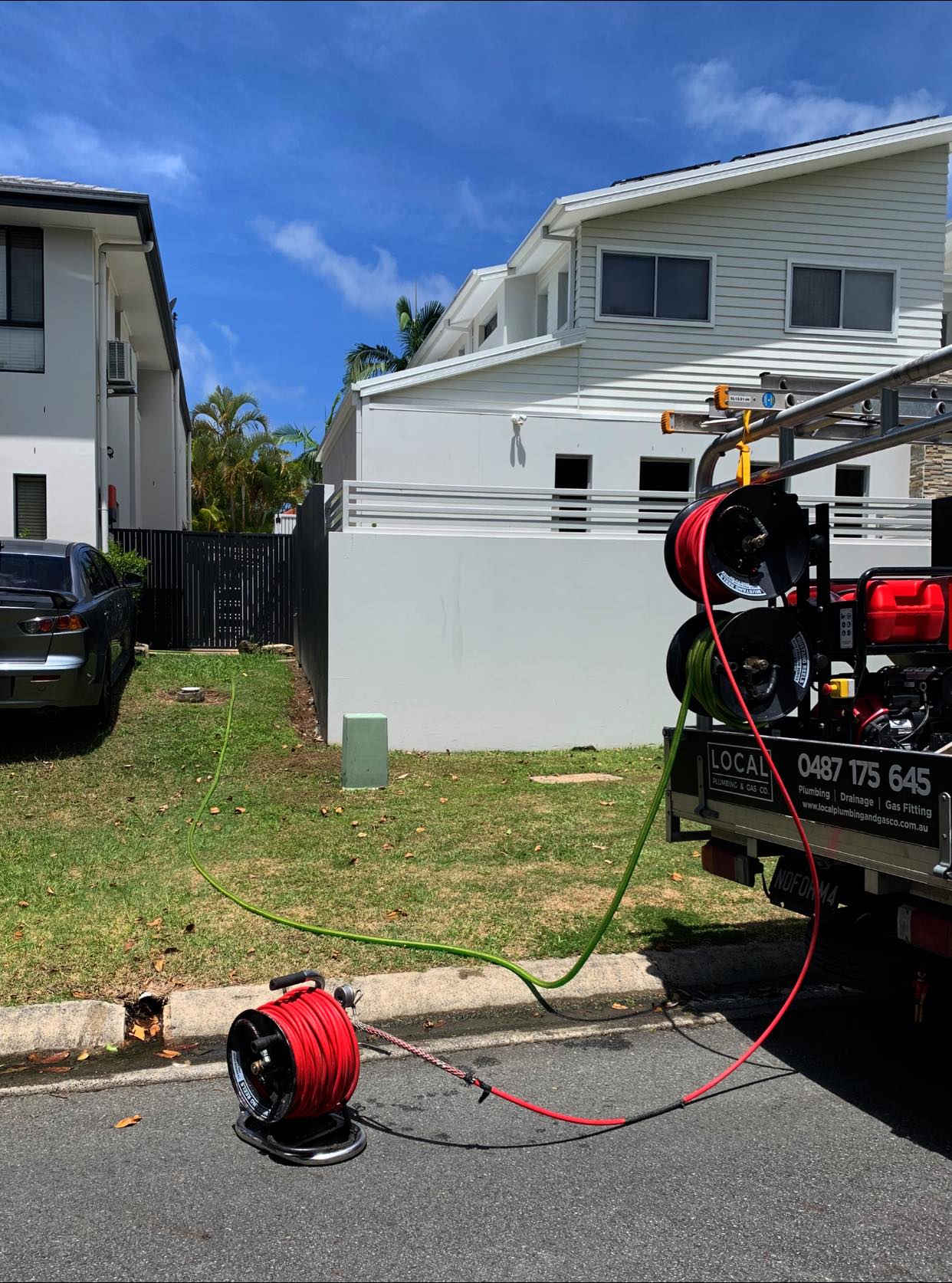
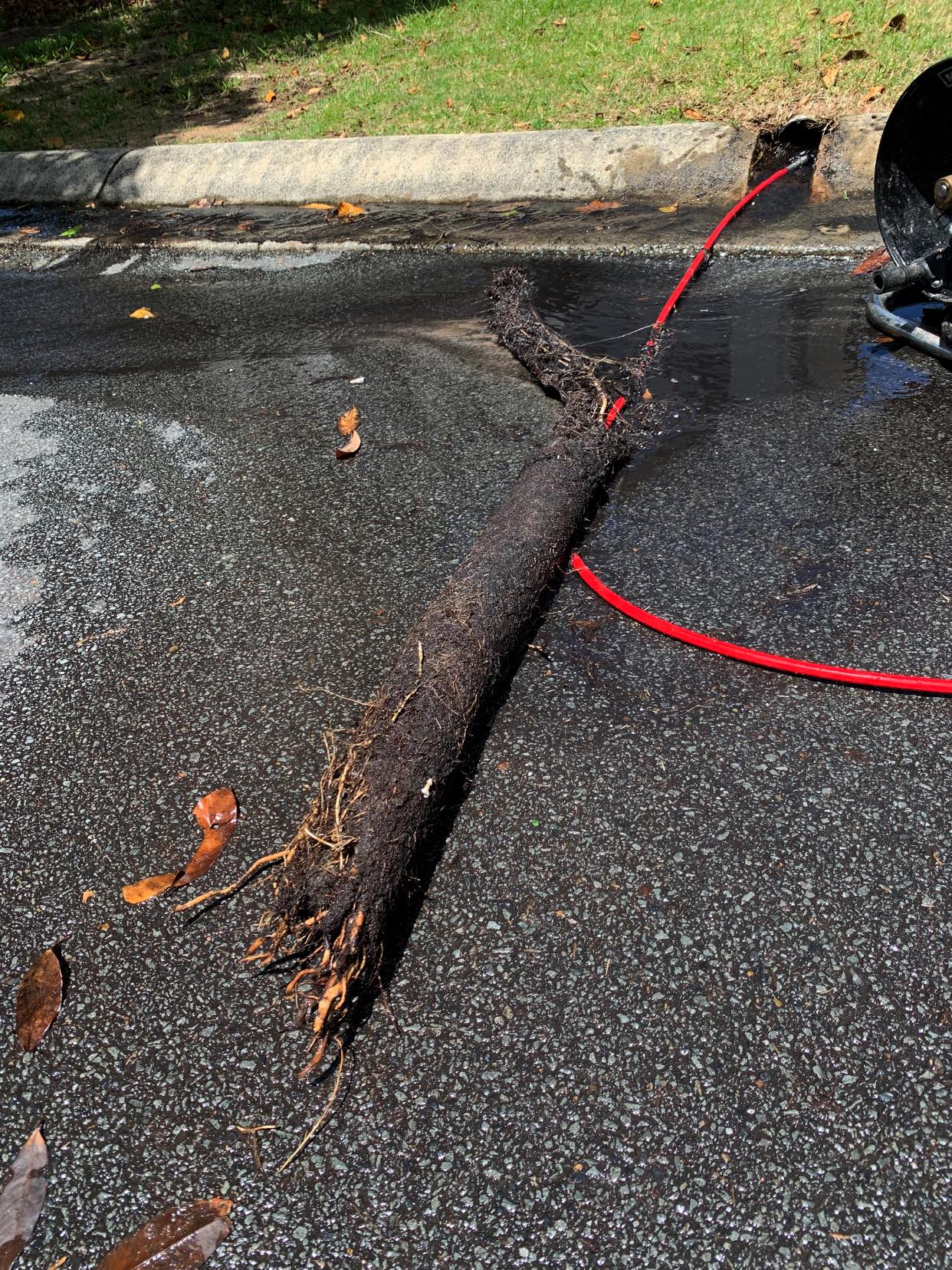
The photos above are from a job our team attended in Robina. The homeowner had noticed recurring slow drainage for several months but hadn’t called it in, assuming it would resolve. By the time we arrived, tree roots had completely blocked the rainwater drain — we pulled out approximately two metres of root mass from the pipe.
The pipe itself was intact enough to clear without relining on this occasion, but the entry point — a deteriorated joint in an older clay section — required sealing to prevent re-intrusion. Total time on site was under two hours. Had the homeowner waited longer, the pressure from the root mass could have cracked the pipe wall, turning a clearance job into a repair.
Preventing Tree Root Intrusion
You can’t control how roots grow once trees are established — but you can reduce the risk significantly, particularly if you’re landscaping a new property or replacing trees.
- Choose lower-risk species near sewer lines. Tree species selection matters more than most homeowners realise. Native trees with less aggressive root systems — lilly pilly, some grevillea varieties, and native palms — are generally safer choices near drainage infrastructure than ficus, poinciana, or eucalyptus.
- Maintain safe tree planting distances. As a practical guide, trees should be planted at least as far from underground pipes as their expected mature height. For large trees on the Gold Coast, that can mean 10–15 metres from sewer laterals.
- Install root barriers. Physical root barriers — typically high-density polyethylene — can be installed to redirect root growth away from pipes. Barriers need to extend at least 60cm deep on the Gold Coast to be effective; larger trees may require deeper installation.
- Schedule regular drain inspections. A periodic CCTV inspection is the most reliable way to catch early-stage intrusion before it becomes structural. Properties in established Gold Coast suburbs with mature trees and older infrastructure are worth inspecting every two to three years as a precaution.
- Address known pipe vulnerabilities proactively. If you know your home has clay or concrete pipes, pipe maintenance — including relining the sewer lateral before roots establish — is significantly cheaper than relining after a blockage and partial collapse. It’s also an option worth considering when doing any renovation that provides access to drainage infrastructure.
Tree Root Intrusion on the Gold Coast — How We Can Help
Local Plumbing & Gas Co. is a licensed plumber on the Gold Coast with QBCC certification and gas fitting qualifications, operating across the region since 2022. Our team handles the full scope of tree root intrusion work — from initial CCTV inspection through to hydro jetting, root cutting, and pipe relining where required.
- QBCC licensed plumbers
- CCTV drain inspection equipment on hand
- Hydro jetting and mechanical root cutting
- Pipe relining for permanent solutions
- $0 call out fee across the Gold Coast
- 24/7 availability
- 107+ Google reviews
If you’re experiencing slow drains, recurring backups, or gurgling that won’t go away, the most useful first step is a camera inspection — it takes the guesswork out of what’s happening inside your pipes. Reach out to our blocked drain plumbers or contact our team to book a CCTV inspection with $0 call out fee across the Gold Coast.